
#5 — My love affair with the algorithm, the endearing self-consciousness of the Brandy Melville café, anti-voyeurism on the Internet
I don’t want to live in a self-imposed echo chamber of my own making.
I love the algorithm (and it’s NOT Stockholm Syndrome)
The Ezra Klein Show recently featuring Kyle Chayka on the pod in an episode entitled “How to Discover Your Own Taste.” Chayka was essentially there to promote his latest book, “Filterworld: How Algorithms Flattened Culture.” It’s a fascinating conversation worth listening to while toiling away on a treadmill (and I do want to read the book — DM if you’re down!!).
Towards the end of the discussion, they talk about how much they “miss curators.” Klein reminisces about the “Internet that [he] came up in, the Internet of blogs, of very early social media, [when] curation was such an important word.” “Curators of interesting links,” in his opinion, are missing today (he cites Tumblr as an example of where they flourished). “People had these weird websites where they put up things they liked on them…that all got eaten by algorithms…it’s hard to find a human being exposing you to their taste.”
With all due respect, Mr. Klein, I must stop you here: the totality of my Instagram feed is human beings exposing me to their taste. I follow hundreds of accounts that “curate” images within their niche interests that happen to line up with mine, interests I’ve had all along or interests only discovered upon finding their accounts — esoteric shoes, spiritual girlhood, quirked-up text-on-shirt, to name a few. Sure, sometimes images are served to me via algorithmic recommendation, but the algorithm does not often miss. Speaking specifically about Instagram, the “social app” I use the most — I tend to like the things I see (sure, this is because of the data they are collecting about me, but that’s a topic for a different conversation: to what extent are you willing to fork over your data in exchange for seeing the things that you like), and even the things I don’t like, I am happy I saw, because they alert me to the state of the world. For example, this sponsored reel I was served the other day for an allegedly non-AI-powered app called Euforia: Voice that Loves You (yes I downloaded, for anthropological research purposes of course..[saving this to dissect another day..]):
Kyle Chayka mourns how the “algorithmic feeds” have “ruined” things in that “we don’t know who we’re going to see so much anymore, like we can’t be sure that we’re listening to the same set of people or hearing the same niche voice that we really wanted to follow.” I actually see this as a positive: the sense of not-knowing is part of the fun. I don’t want to live in a self-imposed echo chamber of my own making.
I do think he has a point in that, if I’m not surfing particularly mindfully, the voices — particularly those recommended to me — can coalesce to become one: instead of keeping up with unique individual perspectives, I enter the network of voices. I take a seat on the cybernetic merry-go-round (there are infinite seats — do you want to come? never mind, you’re already here if you’re reading this..). The merry-go-round revolves faster and faster, around and around and around. I can’t tell who is who. It’s hard to get off. There is only one narrative, with infinite meta-narratives, constantly multiplying…
I’ve been thinking about how, when I scroll, when image after image from account after account, each occupying the container of Post, show themselves to me in consequent order, if I’m lucky, I can begin to tap into a semi-schizophrenic mentality where I subconsciously attempt to find connections between what superficially appear as disparate entities. The human mind is constantly searching for meaning, and here I can exploit this unexplainedly incorrigible trait to decrypt my found ciphers. It’s so much fun!!!
♡ OAT MILK ONLY ♡ @ the Brandy Melville café
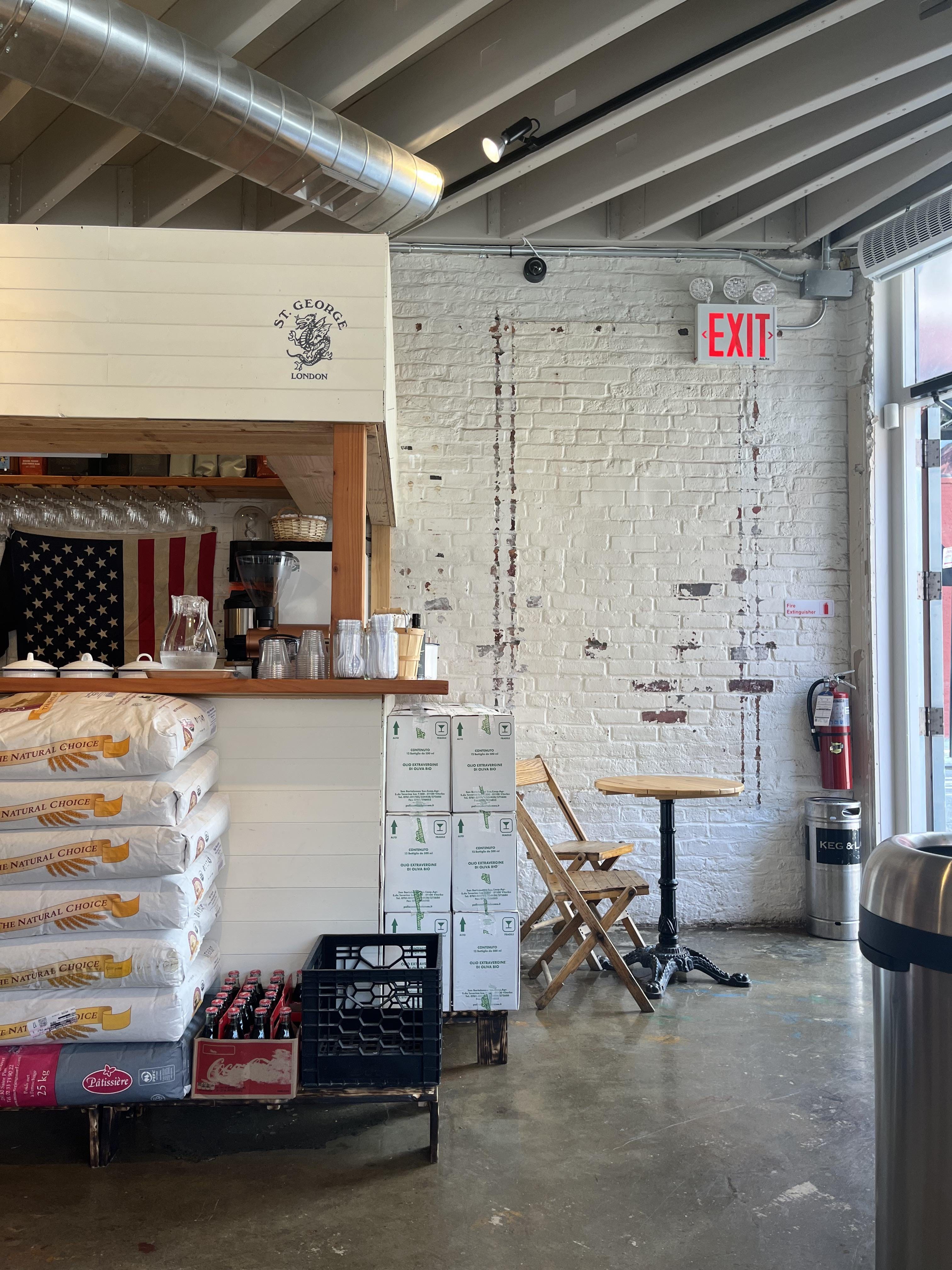
Last Thursday, I met a friend at St. George’s, the Brandy Melville café in West Village.
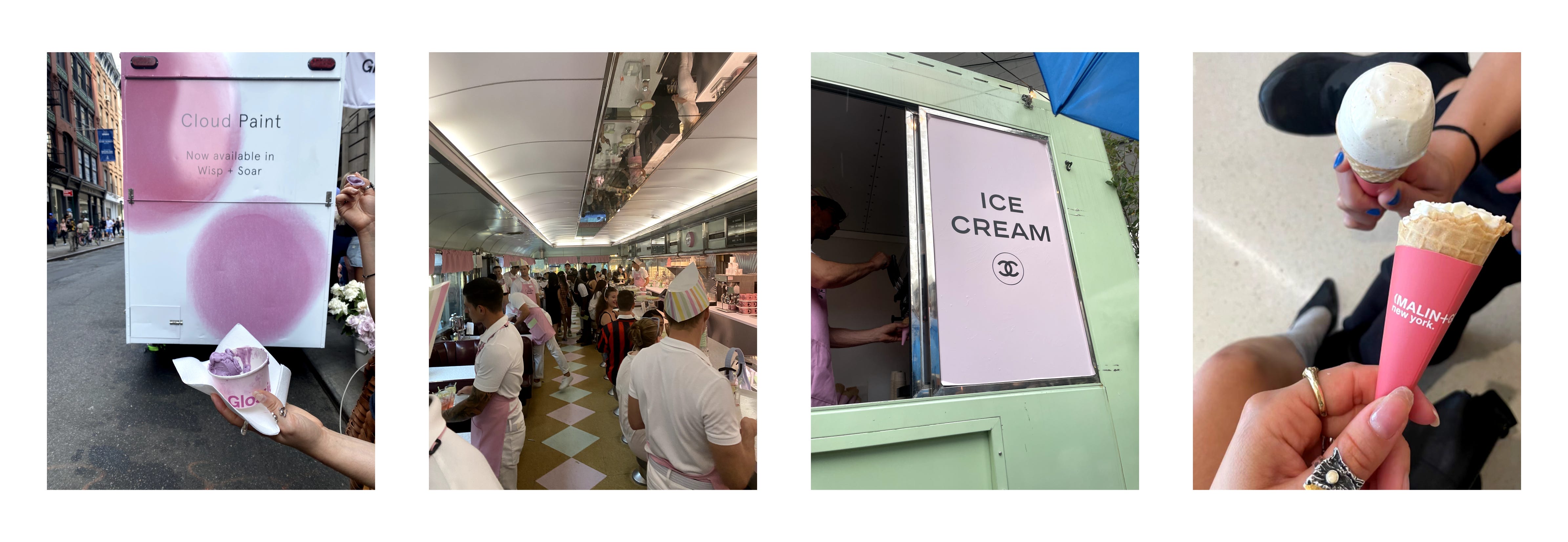
I think that going restaurant mode as a brand is possibly one of the gimmickiest things you can do, but I absolutely love when it happens. The phenomenon isn’t new — in New York City, Ralph Lauren has Ralph’s, a coffee shop — the MOMA (a museum is a brand, too..) has The Modern, a Michelin-star restaurant. Not to mention all the recent pop-ups from Glossier (sorbet inspired by new Cloud Paint colors) to Chanel (diner-takeover in Williamsburg). We had a MALIN+GOETZ ice cream popup to celebrate their new strawberry perfume at Condé Nast once.
Consider the concept of culinary diplomacy, which essentially explains why there are so many Thai restaurants in New York City. Also known as gastrodiplomacy, it’s predicated on the idea that “the easiest way to win hearts and minds is through the stomach.” In an effort to increase its exports and tourism, and its distinction in culture and diplomacy, the government of Thailand went so far as to tender loans to Thai citizens to start restaurants abroad. I have a t-shirt that says MAKE FOOD NOT WAR.
Brands indulging in a form of this — brand diplomacy? — is a way for them to associate themselves with something purportedly TASTY — food is notoriously a catalyst for emotion — subconsciously making you like them more, theoretically making you more likely to buy their products.
I would hypothesize that, more often than not, this actually just ends up inducing existing customers to engage with your brand, not necessarily attracting new ones — if I’m not a real Glossierhead, it’s unlikely I will care to stay in line for the Cloud Paint sorbet. Personally, I just love seeing the different shapes into which a brand will contort itself to sell something. It’s just so funny to think that there was probably an entire focus group convened, multiple bureaucratic layers bulldozed, and at least a dozen signatures signed-off that led to me holding my silly Chanel vanilla ice cream cone. It’s so cute the lengths a brand will go to make you like them. They’re like insecure teenage girls. ♡
WELL-BEHAVED WOMEN RARELY MAKE CRINGE CONTENT ONLINE
Did you know they sell fake security cameras at the Dollar Tree? I wish Foucault were alive to see this. There’s this theory of the watching-eye effect, which suggests that people behave themselves around mere images of eyes — the image becomes the real, and they start to feel like they’re being watched.
This gives new meaning to all those evil eye necklaces and bracelets — instead of simply guarding against the envious stare of the other, maybe they serve a dual purpose: maybe they let the other know you are aware, that you are watching, and that they should know their place.
If you consider “good behavior” to be the kind of behavior you exhibit when in the physical presence of other people, it follows that on the Internet — in the digital presence of other people — the watching-eye effect reverses, or completely ceases to function. There’s so much that people admit to anonymously online that they’d never admit to “in real life,” so much that is posted that would be embarrassing if the behind-the-scenes were seen (and often still is embarrassing because you can simply imagine it).1
Once, I saw Gigi Hadid modeling for some commercial or editorial — is there a material difference? — trailed by a gang of grips and photographers and videographers right outside Mr. Fong’s and I was overcome with secondhand humiliation for her, at the thought of the inevitable TikTokification of whatever she was filming, at all the fated Slays and Mothers that would haunt those images. At Book Club (eternally overrated bookstore/café/bar) in East Village I saw an influencer-type pretending to read a book while her friend dutifully filmed her performance (girl get out of there!!!). There were hordes of people there (Book Club went viral on TikTok) and she didn’t even flinch!
Is there a material difference between Gigi Hadid and this anonymous wannabe influencer? They elicited the same reaction from me, but in most people’s eyes I would venture to say that if Gigi were fake-reading a book in front of a camera crew the moment would be seen as slay rather than cringe. Does it only elicit a mainstream cringe if the person isn’t already famous? Trying to get famous is cringe but being famous is apparently slay. Fascinating! I feel like a scientist wearing a prim white coat having a eureka moment in my own private laboratory. #WomenInSTEM!
There’s this great scene in Nathan Fielder’s The Curse where his character helps the Emma Stone character take off her sweater and it’s this whole ordeal because it’s so tight and so the moment becomes organically funny but then she puts it back on and tells him to do it again, this time with cam on so she can get it for their socials, but he takes it off way too easily and she tells him he did it too fast and now it’s not as funny..